
Aakar Patel is a writer and columnist. You can e-mail the author at aakar.patel@gmail.com

We do not know, because there has been no discussion, no transparency and most likely no real thinking on this matter at our end, observes Aakar Patel.

Since 2014, India has left its moorings as a pluralist, modern, secular State because that is how the BJP wants it to be, notes Aakar Patel.
It is hard to escape the feeling that solving the problems of 2020 and 2021 will require something special which at the moment is not on view, observes Aakar Patel.

Perhaps it says something more deep and profound about the time we live in and how it has shaped us, observes Aakar Patel.

Like on Pegasus, like Covid, there have been no answers from the government about why the situation on the economy and India's future is where it is today, notes Aakar Patel.
It should stop what it is deliberately doing to the NGO sector and let it operate as freely as the rest of the private sector, asserts Aakar Patel.

None of them had anything to do with the violence at Bhima Koregaon, where they were not even present, points out Aakar Patel.
The government did not tell us why our economy had imploded. The prime minister simply stopped speaking on the subject, asserts Aakar Patel.

After 24 months of slowdown beginning in January 2018 before the pandemic and then 18 months of collapse since January 2020, we have become the world's worst performing economy, observes Aakar Patel.
A report by the Azim Premji University showed that during the pandemic 270 million Indians were pushed into poverty. Meaning that they were not poor according to the government poverty line before, but have become now. Aakar Patel mulls on the state of the nation as the Modi government enters its eighth year.
Social media is reflecting a reality that the BJP does not want communicated. More people are saying things on social media that are upsetting the government, asserts Aakar Patel.

'We had decided that India was unique and had overcome Covid.' 'Other nations ordered vaccines on time.' 'They let their scientists determine whether the battle against the pandemic was won instead of a divinely inspired leadership,' asserts Aakar Patel.

A person who has Covid but also has another disease can be classified as a Covid death or not. It serves the immediate purpose of the government to pretend that the official number is low because it makes it appear less incompetent and helpless than it is, points out Aakar Patel.

As India suffers and the ruling party is on the defensive, the truth is that the only way that this wave will pass is if exponential growth of the virus stops on its own, asserts Aakar Patel.
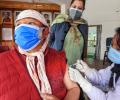
We are today carrying out the reconstruction of New Delhi which will cost us Rs 20,000 crore and give the prime minister a new house while crores of people have no means and no money to buy vaccines for their children, observes Aakar Patel.

'Many Indians are not voting mostly on the basis of issues like the economy and their own well-being as measured by data provided by the government.' 'They seem to be as concerned and perhaps more concerned about other things, especially those that have to do with the harassment of India's minorities,' asserts Aakar Patel.

The government is attempting everything it can to make sure that this does not happen, observes Aakar Patel.

Why did we go into nationwide lockdown when we were adding 100 cases a day and why are we not going into lockdown but allowing cricket stadiums, political rallies and Kumbh Melas when we are adding 40,000 cases a day? asks Aakar Patel.

The prime minister says he will bring real change to Bengal. Perhaps he will. The interesting thing is that his party has never defined what this change is, observes Aakar Patel.

Our precipitous decline is being noticed and recorded abroad with alarm. It is strange that within India we are carrying on as if it is business as usual, observes Aakar Patel.
